

As you launch your SEO services offering, one of the most important components of your marketing collateral is an engaging SEO sales page on your agency website. This is where you introduce your SEO services to prospective clients. It’s also where you share the agency's approach to SEO and the benefits of having the service.
Remember, the goal of an SEO sales page is lead generation.
As you sit down to write web copy for this page, first explore other SEO service providers' websites for added guidance. When you do, you’ll quickly find copywriting verbiage claiming heavyweight titles such as:
- #1 Best SEO Agency
- Superior On-Site Optimization
- Quality Link Building
- Results Guaranteed
We’ve been over this and know all too well that these kinds of false promises are bad for business. So before you mimic what you see everywhere else, ask yourself is this the type of sales page that you want to create?
In this post, Pathfinder SEO shares the ingredients for creating a high-value SEO sales page using a simple six-step process.
This Post is Part of a Series about Marketing SEO Services:
How to Create an SEO Sales Page
At Pathfinder SEO, we have adopted a six-step process for creating an engaging SEO sales page to attract your ideal client. In fact, the ideal client is exactly where it all begins.
1. Start with the Audience
Before beginning to build your SEO sales page, return to the audience which you serve. Who is the ideal client that your agency is looking to attract?
Keep this ideal client at the forefront of your mind when creating the web copy because the content needs to target their specific problems and speak to their goals.
For example, if you target local businesses, then perhaps your content will focus on issues centered around budget constraints and the need to have a highly focused campaign.
Alternatively, if targeting large organizations, then speaking to the needs centered around collaboration within internal departments to generate stronger SEO results is the preferred marketing message.
Which of the three descriptions below speaks to your agency’s target audience?
- Industry-based: Your SEO services are designed for a specific industry like construction companies, yoga studios, eCommerce websites, or SaaS businesses.
- Location-based: Your SEO services target businesses in a specific geographic area like Minneapolis, Boulder, or Seattle.
- CMS-based: Your SEO services target businesses powered by specific content management systems such as WordPress, Shopify, or Squarespace.
It’s possible to target a combination of all three platforms such as “Minnesota construction company SEO” or “Colorado local SEO”. What’s important is to clearly define this audience before creating any web copy so as not to upset or overlook any primary keyword usage.
Once you have your audience defined, you are ready to engage in keyword research.
2. Engage in Keyword Research
Turn to Google and utilize the search engine results to suggest keyword ideas for your agency’s SEO sales page. This process can help you uncover keywords your target audience frequently uses to find services similar to yours.
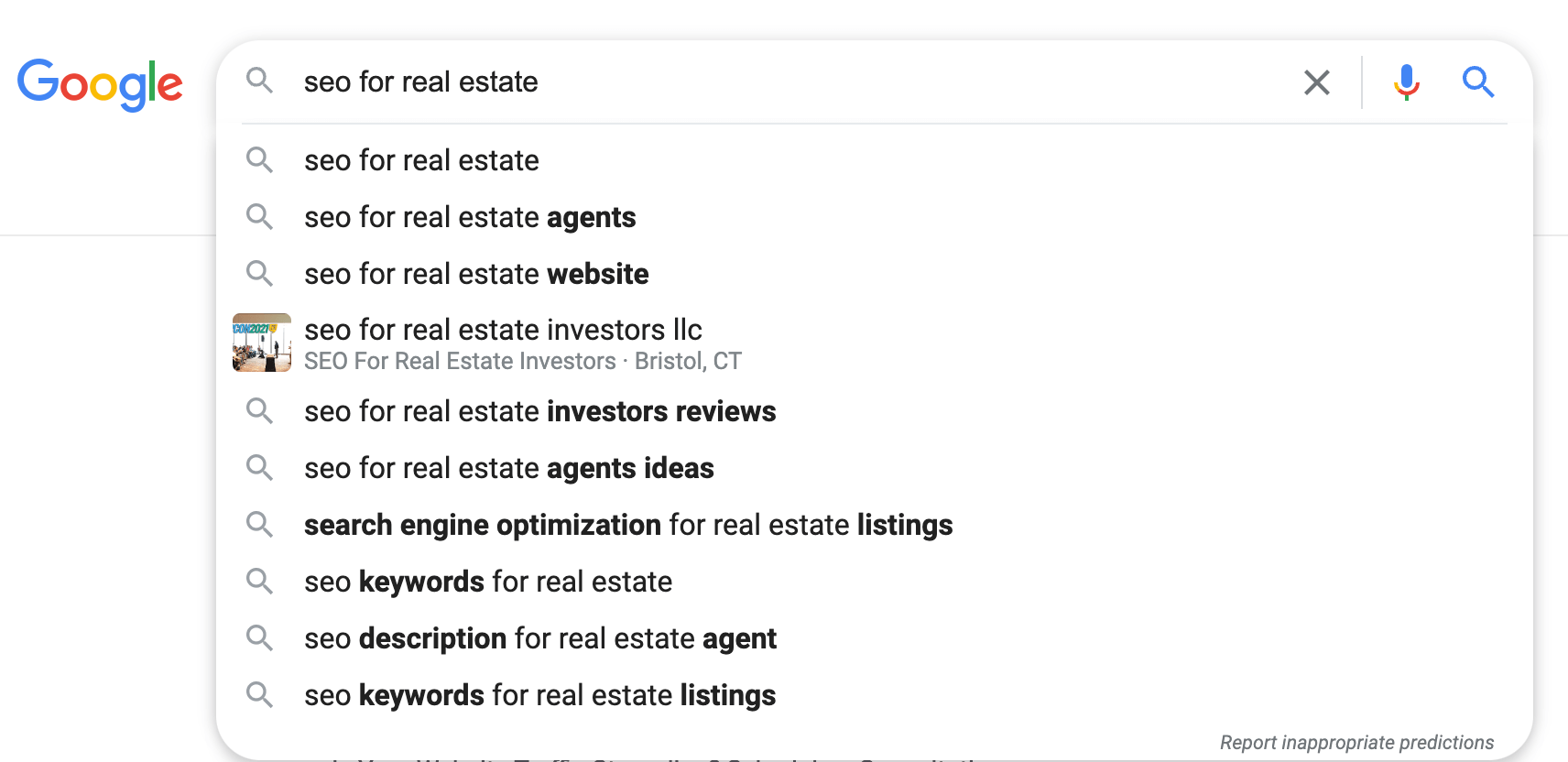
Create a list of those relevant keywords found. Use basic combinations of “SEO service”, “SEO agency” “SEO for”, “SEO consultants,” in your initial search paired with words relating to your specific platform focus.
For example, if you target construction companies, your list of relevant keywords may look like: construction company SEO, SEO for construction companies, SEO services for construction companies, SEO agency for construction companies.
Don’t forget to think outside of the box, either. Try adding alternative phrases businesses might also search in order to find your webpage like “SEO for builders” or “SEO agency for builders”.
Then confirm the search volume for these phrases using a keyword research utility. Pathfinder SEO subscribers have access to our integrated keyword research tool to make this step quick and easy.
Now that you’ve constructed a solid list of relevant keywords, you can begin to draft the web copy taking care to organically integrate them into the content. This will help your new SEO services page attract the right kind of traffic from Google.
3. Define your Page Structure
Sitting down to write the web copy for a new and engaging SEO sales page can be daunting. Instead of starting from scratch, consider using a sales page framework to create a flow for your webpage. Here are examples of core content blocks to consider:
- Headline: Captures the attention of the ideal client and clearly conveys product benefits.
- Problem: Connect with your audience by articulating a specific problem niche regularly faces.
- Solution: Tell your ideal client exactly how your service(s) solves their problems.
- Method: Explain how your process works with the client’s business goals in mind.
- Proof: Demonstrate that you can deliver these results via testimonials or case studies.
- Call to Action: Provide a way for your ideal client to take action by filling out a form, emailing, purchasing, etc.
- FAQ: Alleviate any remaining concerns about working with you by answering common questions about your service(s).
With the page structuring in a cohesive flow, the web copy becomes far less daunting to execute. Especially when you take it one section at a time.
4. Write Copy for Each Section
You know your target audience, keywords, and have an outline for your engaging SEO sales page. Now it’s time to write.
Let’s break down each section in more detail. If you get stuck in one section, move forward to the next. You can circle back to refine and improve your copywriting as often as necessary in this process.
Headline
The headline is the first thing a potential client reads. It defines what you are selling and helps them identify if they are in the right place.
In a headline, we seek to:
- Tell people what you are offering
- Utilize your page’s target keyword
- Compel people to keep reading by conveying the benefits your service offers
That’s a lot and this is often the hardest part to effectively execute on the page. We recommend brainstorming 4-6 headlines for your page to start. Set them each aside and come back to them in a bit.
Problem
Once you have your customer’s attention with the headline, it is time to build rapport. All humans have an innate need to feel seen and heard. One of the best ways to do this is by relating to your customer’s pain points — the problems they’re hoping to solve with your SEO services.
Ask your prospective customers a simple question, “How have you approached SEO in the past”? This answer is almost always a story that highlights their pain point. Your job is to integrate your clients’ own words back to them through this web copy.
Common pain points for business owners include:
- Cost — Investing in SEO and not seeing a return.
- Time — Not having the time to invest in their SEO and not wanting to be an SEO expert.
- Change — It feels like the game is always changing and they want to know how to stay on top of it.
Your goal with this section of the web copy is to reassure the prospective client that wherever they are today is perfectly OK. And that, yes, SEO is challenging, but there’s also a solution.
Solution
Now that we’ve created trust with our audience through acknowledgment, it’s time to reveal the solution; your SEO service(s).
Outline in detail how your services solve their problem(s).
Although you could likely write a book about the solution topic, avoid creating lengthy copy. It isn’t always better to overexplain. Communicate the clear benefits as bullet points and focus on the emotional outcome the solution will have.
Method
Our goal with this section of the web copy is to demonstrate a proven method of providing a high-level overview of your process to your potential clientele.
Here’s an example from our agency website in more detail. If you are following our guided approach to delivering SEO services, then your process will look similar:

The SEO Assessment aligns with “Immerse”. It’s during this phase of the campaign that we assess and define strategy.
The SEO Set-Up aligns with “Build”. It’s during this phase of the campaign that we build a foundation and expand on the strategy to outline exactly how we’ll approach content marketing and off-site SEO.
Monthly SEO services align with “Evolve”. It’s during this phase that we continually maintain and grow the foundation via content marketing, SEO maintenance, and more.
Proof
Once you’ve shown your potential clients that you understand their struggles and can solve their problems, it’s time to show them that you can produce real-world results, too.
Some of the most useful tools for doing this are:
- Case studies
- Testimonials from a real client
- Business performance stats and data
- Mentions in the media
- Recognizable client logos
Use whichever elements will resonate with your audience most. And don’t be afraid to combine or use multiple elements, either.
Call to Action
How does your prospect get started? Is it a contact form? Do you want them to call you? It’s time to present your call to action.
Here’s an example of web copy that inspires action:

What will your call to action be?
FAQ
It’s not cliche to have a frequently asked questions section on your webpage. An FAQ section creates the opportunity to mitigate objections.
Think about what reasons a prospect may not reach out. Are they worried about the cost? Are they not sure they are ready for the service? Have they been burned by another SEO agency in the past and are hesitant to re-engage?
Create a list of questions that will reassure prospects of the value of your service. Examples include:
- When will I see the results?
- My website isn't live yet. When should I get started with SEO?
- Are content marketing services included?
- Can I utilize your services with WordPress, Squarespace, Wix, Drupal, or other content management systems?
5. Build the Page with Great Design
Copywriting is complete, now it’s time to build the SEO sales page on your website. Friendly reminder that user-experience matters. It impacts your return visitors and the search engine rankings, too.
If you are a designer, it’s time to put your skills to good use on your website. If not, consider hiring a professional web designer to ensure your agency website and the SEO sales page have great design and thus create a memorable user experience.
Check out the dedicated designers at GoWP, or the project-based services at Design Pickle or Deer Design if you don’t already have a trusted resource.
6. Publish
Congratulations! It’s now time to publish your SEO sales page. If you still feel like you require additional guidance, consider reviewing the on-page optimization available to you on our website.
Update your page title and meta description to utilize your core keywords and to encourage the right amount of clicks.
Review images to ensure they have proper alternative text included, this can bring clients to your web page as well. Improving your Google ranking over time.
Frequently Asked Questions
FAQs aren’t just for your ideal client. We know that you probably have a few questions of your own, too. Check out a few of the more common questions agencies have when creating an SEO sales page below:
Should I include pricing on my SEO sales page?
We don’t recommend it. Including pricing on the sales page can make some people feel like it’s too expensive and others too inexpensive. Either way, you won’t get the lead which is the goal of the page.
You may worry that without pricing, you’ll attract unqualified leads. To avoid this make sure your copy targets your audience so that a visitor knows they are at the place before inviting them to complete a contact form.
What if I’m stuck?
First and foremost, know you aren’t alone. When we wrote the marketing copy for the SEO sales page on our agency website, it took time. Especially considering it’s not heavy on content.
Take a step back from the project and then return to it a day or a couple of hours later. If you are still stuck, consider signing up for Pathfinder SEO so you can get one-on-one coaching to help get you moving forward. Our team will help you accelerate the copywriting process alongside you the entire time.
What's Next?
Begin to create your engaging SEO sales page by following the six-step process above. Then, you are ready to start marketing your new webpage.
Learn more about how to introduce your SEO services offering to your current customers.
We’re Here to Help
We built Pathfinder SEO for agencies like yours who are looking to start and scale their SEO services offering. We’ll accelerate you through the process and help you avoid costly mistakes.
A subscription to the Pathfinder SEO platform includes access to all the resources you need to create your SEO services offering and effectively deliver the service. That includes templates, process documentation, and built-in SEO tools.
New Pathfinder SEO subscribers receive two free onboarding sessions with our SEO coaches.
Sign up for a subscription today.
